
How Virtual Sitting Is Improving Patient Observation and Safety
March 31, 2026
The Growing Challenge of Patient Observation
Hospitals have long relied on in-room sitters to monitor patients who may be at risk for falls, delirium, self-harm, or behavioral escalation. Assigning a staff member to remain with a patient at all times can be an effective way to reduce safety risks and ensure immediate intervention when needed.
However, the traditional one-to-one sitter model has become increasingly difficult to sustain. Persistent staffing shortages, fluctuating patient volumes, and rising operational costs are forcing hospitals to rethink how observation coverage is delivered.
At the same time, the number of patients who require some level of monitoring continues to grow. Patients experiencing confusion, delirium, medication side effects, or behavioral distress often need continuous observation, even when they do not require constant physical intervention.
In response, many hospitals are exploring virtual sitting as a complementary approach that expands observation capacity while maintaining patient safety.
What Virtual Sitting Is
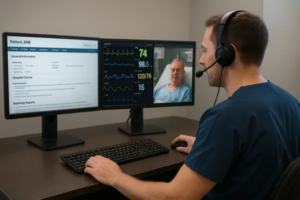
Virtual sitting uses trained clinical observers who monitor patients remotely through secure video technology. These observers typically work from centralized monitoring stations where they can observe multiple patients simultaneously and communicate directly with on-site teams.
When a patient exhibits behaviors that could lead to a fall, injury, or other safety concern, the observer immediately alerts clinical staff to enable intervention.
Virtual sitters follow established observation protocols and escalation pathways aligned with hospital safety policies. This ensures that concerns are addressed consistently and that in-person teams receive timely information about patient activity.
Importantly, virtual sitting is not designed to replace all in-room sitters. Instead, it provides an additional layer of observation, allowing hospitals to extend monitoring coverage where continuous physical presence may not be clinically necessary.
When Virtual Sitting Works Best
Hospitals tend to see the greatest value from virtual sitting in situations where continuous observation is needed, but direct physical intervention is only occasionally required.
Common use cases include:
- Patients at risk for falls who require visual monitoring
- Patients experiencing confusion or delirium
- Post-operative patients recovering from sedation
- Behavioral monitoring on medical-surgical units
- Patients who attempt to remove lines or medical devices
In these situations, virtual observers can identify early-warning behaviors such as restlessness, attempts to leave the bed, or signs of agitation. This allows on-site staff to intervene before a safety event occurs.
By expanding observation coverage without requiring additional unit staff, hospitals can maintain patient safety while managing staffing constraints more effectively.
Maintaining Consistent Observation Coverage
One challenge with traditional sitter coverage is variability. Availability often depends on staffing levels, shift coverage, or unit demand. During busy periods, hospitals may struggle to provide sitters for every patient who could benefit from continuous observation.
Virtual sitting helps address this variability by centralizing observation responsibilities. Because trained observers are dedicated to monitoring tasks, coverage can remain consistent regardless of fluctuations in unit staffing.
This consistency can be especially valuable during overnight hours, when delirium and confusion often worsen, and staffing resources may be more limited.
Maintaining reliable observation across shifts helps hospitals support patient safety goals tied to fall prevention, adverse event reduction, and timely escalation.
Supporting Teams
Virtual sitting also provides meaningful support for on-site clinicians.
Nurses and patient care technicians often balance numerous responsibilities, including medication administration, documentation, patient assessments, and care coordination. Monitoring patients continuously while managing these responsibilities can be challenging, particularly during busy shifts.
Virtual observers act as an additional set of eyes for the care team. They monitor patient activity, document behaviors, and alert staff when intervention may be needed.
This support allows in-person teams to respond more quickly and with better information while reducing the need for constant in-room observation when it is not clinically necessary.
Rather than replacing on-site care, virtual sitting helps distribute observation responsibilities more effectively across the care team.
Technology and Workflow Integration
Successful virtual sitting programs rely on secure video monitoring platforms that provide observers with clear visibility of patients while protecting privacy and compliance standards.
Observers communicate with on-site care teams through established escalation pathways, which may include nurse call systems, secure messaging platforms, or direct communication channels.
Integration with existing clinical workflows is essential. Virtual sitting programs are most effective when they align with hospital protocols and are supported by nursing leadership.
When implemented thoughtfully, virtual sitting becomes a natural extension of a hospital’s broader patient safety strategy.
A More Sustainable Approach to Patient Safety
As healthcare organizations continue to navigate workforce shortages and rising care complexity, relying exclusively on traditional staffing models is becoming increasingly difficult.
Virtual sitting provides a practical way to expand observation capacity while protecting staffing resources. By centralizing monitoring and using trained observers to identify early warning behaviors, hospitals can strengthen patient safety without increasing pressure on on-site teams.
When supported by clear protocols and strong clinical oversight, this remote monitoring solution helps hospitals maintain consistent observation coverage even during periods of operational strain.
For many organizations, it represents an important step toward building more resilient and sustainable patient safety programs.