
Stabilizing Clinical Coverage with Virtual Advanced Practice Providers
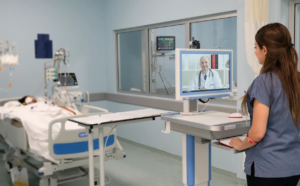
Stabilizing Clinical Coverage with Virtual Advanced Practice Providers
February 25, 2026
How Hospitals Are Adapting to Workforce Volatility
Workforce shortages are no longer episodic disruptions for hospitals navigating today’s operational realities, particularly in providing critical care solutions and specialty coverage. Overnight shifts, weekends, and seasonal surges routinely expose gaps that traditional staffing models struggle to fill.
In response, some hospitals are moving beyond stopgap measures like overtime, traveler contracts, and agency staffing to operationalize virtual Advanced Practice Providers (APPs) as part of their clinical coverage strategy. These providers serve as a stabilizing partner that supports physicians and bedside teams, extending ICU telehealth and teleintensivist services within a comprehensive critical care framework. The result is improved continuity of care during the most vulnerable hours and a more sustainable approach to coverage and clinical support.
From Staffing Shortage to Coverage Reliability
Although staffing conversations often focus on headcount, operational strain usually shows up as coverage variability. The issue is not always a lack of clinicians, but unreliable access to the right level of support when demand spikes or patient conditions deteriorate.
These models address this challenge by extending clinical coverage beyond physical presence. Rather than replacing bedside teams, these remote clinicians function as an integrated support layer, extending continuity during off-hours, reinforcing escalation pathways, and absorbing workloads that would otherwise fall on already stretched clinicians.
For leadership teams, the appeal is practical, with this support layer deployed through virtual critical care models where coverage risk is highest, and staffing volatility has the greatest downstream impact.
Where Remote APPs Create Immediate Operational Value
Hospitals using virtual APPs most effectively tend to focus on specific pressure points rather than broad, undefined use cases.
Common areas of immediate value include overnight coverage, when staffing is leaner but acuity does not slow down. Virtual APPs can support admissions, monitor patient status, assist with clinical decision-making, and facilitate timely escalation without requiring additional on-site staffing.
Weekends present a similar dynamic as variability in coverage can lead to delays, fragmented communication, and increased burden on care providers. Virtual APPs help maintain continuity across shifts and reduce the operational drop-off that often occurs outside weekday hours.
Surge periods are another critical use case. During seasonal increases in volume or unexpected census spikes, virtual APPs provide a flexible way to absorb demand without immediately resorting to overtime or short-term contracts. This approach allows hospitals to respond faster while preserving workforce stability.
Across each scenario, consistency is the differentiator. Virtual APPs function as a critical care solution that reduces the peaks and valleys of coverage, helping hospitals mitigate the downstream impact of staffing volatility.
Integration Into Existing Clinical Workflows
One of the most important indicators of program effectiveness in virtual APP deployments is workflow integration. When they are embedded within existing clinical workflows instead of operating in parallel, these virtual clinicians document within the same electronic medical record, follow established protocols, and communicate through clearly defined escalation pathways.
Seamless integration allows bedside teams to engage remote APP support as they would an in-house colleague—in an operational rather than transactional relationship. They participate in care coordination, provide clinical input aligned with hospital standards, and support decision-making without introducing friction or redundancy.
Remote critical care reduces cognitive load for physicians while providing nursing teams with accessible support during periods of uncertainty or high workload, and it creates greater predictability for leadership in how care is delivered across shifts.
Supporting Physicians Without Adding Burden
While physician burnout is often viewed as a workforce issue, it is also an organizational one. When physicians are consistently pulled into overnight calls, weekend escalations, or surge-related gaps, the strain compounds over time.
Virtual APPs help redistribute that burden by managing routine clinical needs, triaging issues appropriately, and escalating only when necessary. By reducing task-switching, physicians are better able to focus on complex decision-making where their expertise has the greatest impact.
Importantly, this framework preserves physician involvement in care delivery while making it more timely, targeted, and sustainable. Remote clinicians act as a buffer that protects physician bandwidth while maintaining high standards of care.
A More Sustainable Alternative to Agency Staffing
Although agency staffing and overtime remain necessary tools, they are costly and difficult to sustain long-term, introducing financial variability and disrupting team cohesion and continuity. Because this model can be integrated into hospital workflows and aligned with institutional protocols, they provide consistency without turnover or the burden of onboarding, supporting more effective workforce planning over time. Hospitals gain reliable coverage that scales with demand, reducing reliance on reactive staffing solutions, enabling greater cost control, and improving organizational resilience.
Virtual APPs as Part of a Long-Term Coverage Strategy
Hospitals that approach this model as a short-term fix often fail to realize its full potential, while organizations seeing the strongest results treat remote APP coverage as a core component of their staffing strategy. In practice, that means clearly defined roles, alignment with medical leadership, and integration into existing performance structures.
As staffing volatility continues to strain hospitals nationwide, pragmatic solutions are taking precedence over aspirational ones. Remote APP support represents a grounded, operational response to a reality that is unlikely to resolve on its own.
For leadership teams seeking stability, sustainability, and consistent care delivery, the ability to integrate alternative critical care solutions effectively will define operational resilience moving forward.